While the Jedi Code was first laid out in the Expanded Universe, it is based entirely on what we see of the Jedi in the movies. Only the Original Trilogy was out when it was written, but the prequels only clarified that information, didn’t contradict. George Lucas did give guidelines on the Jedi to the authors.
The Jedi Code as seen in the movies
There is no emotion, there is peace.


the beast

This doesn’t mean a Jedi has no feelings. It means focusing on the Force to guide and defend the Republic, and not allowing the emotions to cloud that guidance. The Jedi are to keep their calm in situations most would consider stressful if not terrifying. While Jar Jar Binks was panicking over sea monsters outside the Gungan Bongo, the Jedi Qui-Gon Jinn and Obi-Wan carefully worked to solve the situation.
Neither Anakin or Luke, both of who started training later, were calm when loved ones were in danger. When Anakin’s Mother was killed, he was still an apprentice. Luke too was in training, when Vader captured his friends. Neither had sufficient emotionally control or discipline at the their level of training to be ready to live the Jedi Code at that moment. Notably, Anakin was warned not to go anywhere on that mission (not even to rescue someone) without consulting the Council. It ended with him murdering the sand people. Luke was warned not to leave the training and lost his hand, while also failing to actually save his friends.
“How will I know the good side from the bad?”
Luke Skywalker & Yoda, The Empire Strikes Back
“When you are calm, at peace, passive.”
“Your thoughts dwell on your mother.”
Ki Adi-Mundi, Anakin Skywalker and Yoda in The Phantom Menace
“I miss her.”
“Hmmm afraid to lose her I think.”
“What does that have to do with anything?”
“Everything. Fear leads to anger, anger leads to hate, hate leads to suffering. I sense much fear in you.”
“Don’t center on your anxieties Obi-Wan”. Keep your concentration in the here and now, where it belongs.”
Qui-Gon Jinn to Obi-Wan in the Phantom Menace
There is no ignorance, there is knowledge


A Jedi can often sense things before they happen. The Force forewarns of danger to themselves or others in the vicinity so long as they are alert. The Jedi Temple had a vast archival library and analysis rooms, so that when they went on a mission, they were prepared through research and study.
The Jedi found the dark side clouded the use of the Force to directly gain knowledge as they came closer to the Clone Wars. The knowledge of where and who the enemy was led to their downfall. When Luke rushed after his friends, he did have some knowledge: they were in danger because of him. But he did not have knowledge of what would happen, or sufficient training to be sure of dealing with the situation without falling to the Dark Side.
“A Jedi uses the Force for knowledge and defense, never for attack.”
Yoda, The Empire Strikes Back
“Through the force, things you will see. The future, the past, old friends long gone.”
Yoda, The Empire Strikes Back
“Blind we are, if the creation of this Clone Army we could not see!”
Yoda, Attack of the Clones
There is no passion, there is serenity.
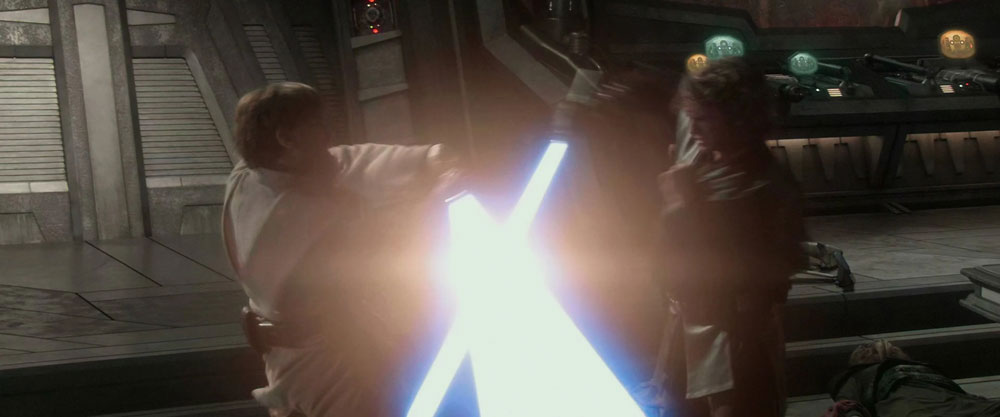

The dictionary defines passion as intense emotions, rage, hate, ardent love. These are all things that can be triggered by an attachment to things, like friends, family, home, that can distract one from the greater need and duty of a Jedi.
Both in the prequels and the original trilogy, giving into strong emotions the Jedi warn against, exactly as the Jedi Code states. Luke’s fear for his friends causes him to rush off, abandoning his training with Yoda. Anakin’s giving in to his rage over losing his mother and panic at the foreseen loss of his wife, had devastating consequences both for him, his family, and the galaxy. It led to him putting his own selfish fear of losing Padmé, over the needs of the galaxy (or for that matter, what even his wife wanted).
“Don’t give into hate, that leads to the dark side.”
Spirit Obi-Wan to Luke in The Empire Strikes Back
‘Fear leads to anger, anger leads to hate, hate leads to suffering.
Yoda in the Phantom Menace
Anakin on some level did live by this Jedi code before he fell. He struggled with it and was disappointed with himself when he failed. But he came to the Jedi Order “attached”. He was attached to his mother and feared letting her go. Attachment and a need for someone to love was very much part of who he was. That attachment led to emotional ties that few other Jedi had to deal with, and therefore it made it that much harder to accept their advice.
Anakin ends up in love with Padmé, starting with a childhood crush but becoming a passionate love. But his love and fear of losing his mother had already led him to give into rage once. When his fear of losing his wife led him to give into Palpatine, he lost all, his own need to keep her safe destroyed her and his own identity. He lived in a world of pain, physically and emotionally after becoming Vader, particularly after Mustafar.
“I’d rather dream about Padme.”
Anakin and Obi-Wan, while guarding Padmé
“Be careful of your thoughts, Anakin, you have made a committment to the Jedi Order not easily broken.”
“Are you allowed to love?”
Padmé and Anakin, Attack of the Clones
“Attachment is forbidden. Possession is forbidden. Compassion, which I would define as unconditional love, is central to a Jedi’s life.”
“Anything is possible Padme, listen to me!”
Padmé to and Anakin, Attack of the Clones
“I will not let you give up your future for me!”
“We could keep it a secret.”
“We’d be living a lie…I couldn’t live that way could you?”
“No…your right. It would destroy us.”
“Attachment leads to jealousy. The shadow of greed, that is.”
Yoda to Anakin in Revenge of the Sith
Luke was also attached. He had no power to lash out when his Aunt and Uncle were murdered. But when his friends were threatened he did pursue them. In the end though, at the crisis moment, Luke let go of this attachment. He knew falling to the Dark Side himself would not save them. The evidence was right before his eyes. He may not know why his father fell, but he knew Anakin had been a good man once.
It isn’t until Anakin sees his own son following the Jedi Code, acting as a Jedi, that he selflessly remembers how to do the same. He turns from being Darth Vader and releases his attachment to his life and his power.
There is no death there is the Force.

The final step of the Jedi Code is handling death. In the Original Trilogy we saw the Jedi become one with the Force, for Luke to both hear and see. Only in the prequels do we find this wasn’t common. In fact, it was a rare, long lost ability. Yoda didn’t so much give Anakin bad advice regarding death, so much as he delivered it rather badly. It was delivered somewhat better in the novelization (in lines that were probably from an earlier version of the script) where Yoda clarified this was about the dangers of Anakin’s fear and where it could lead him rather than that they shouldn’t defend the innocent from being killed.
“Rejoice for those who transform into the force.”
Yoda to Anakin in Revenge of the Sith
“An old friend has learned the path to immortality”
Yoda to Obi-Wan, Revenge of the Sith
“Who?”
One who has returned from the netherworld
of the Force to train me… your old
Master, Qui-Gon Jinn”.
Taking the six movies in context, it’s clear the code isn’t mean to stifle a Jedi being a normal, feeling being. It is meant to make them someone who controls feelings that are extremely difficult to deal with. Familial feelings are by their very nature, powerful. Hence the Jedi starting so very young usually with their training Once that bond is formed, it’s very difficult to temper it with the needed control.
Expanded Universe, Jedi Code Evolution
The creator, George Lucas did have to sign off on details of the Jedi for Tales of the Jedi, and that is the source from which the written Jedi code sprang, as it was the root of the Jedi Academy series and Knights of the Old Republic. But the code doesn’t and cannot contradict the movies. Only one’s understanding of it is clarified. In all likelihood, he hadn’t yet decided the Jedi of Anakin’s and Obi-Wan’s time would forbid such attachments. Yoda’s recognizing that strength in the Force was passed on in families suggests the rule forbidding marriage & family had not always been so strict.
In the books and comics, the Jedi Code fits well with what we see in the prequel movies. From Tales of the Jedi up to to the prequel era, we see an evolution of the code from more permissive to the far more strict version that our movie heroes were born to. Anakin ran afoul of the ’emotion’ issue more than once just as in the movies. He formed preconceptions based on his expectation. Since this character had caused him trouble before, he must be the threat now for instance. Since a Jedi’s ultimate goal is to be a keeper of the peace, this was limiting his effectiveness since it affected his discernment.
In fact, the Expanded Universe itself predicts the prequel attitude in Children of the Jedi even as it at first glance seemed to contradict it. What are families to do when most are Jedi or Force sensitive but one is born who is not? Therefore, the few of that era that were trained at older ages were by those who defied the Council (as Qui-Gon himself had planned to do.) These often ended up with their grown children or grandchildren in Luke Skywalker’s Jedi Order, using what their family had secretly passed down.
Primary Sources of the Jedi Code
- Tales of the Jedi Companion
- Jedi Academy Trilogy by Kevin J. Anderson
- Jedi Academy Sourcebook
- Young Jedi Knights series by Kevin J. Anderson & Rebecca Moesta
- Knights of the Old Republic (game)
- Jedi VS Sith, the Essential Guide to the Force
- Star Wars Episode 1 The Phantom Menace Oral History (George Lucas talks about attachment)
